Agile engineering with AI: keep the Definition of Done meaningful
Adapt your development workflow for AI-generated changes while preserving usable increments, honest review, and release ownership.
The useful starting point
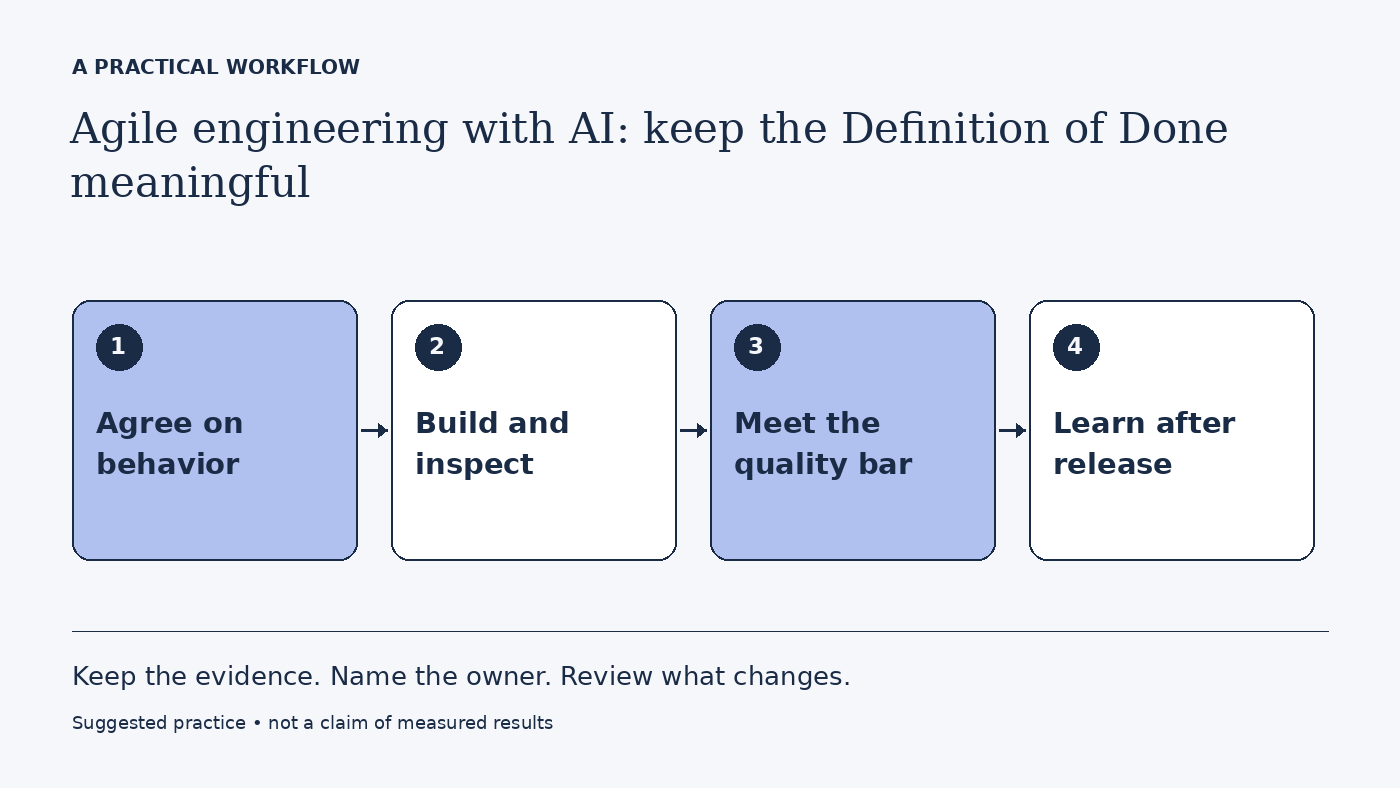
AI changes how work is produced, not the need to verify it. Keep a shared goal, small changes, explicit quality criteria, and a feedback loop that includes production behavior.
In this guide
A generated implementation can look complete before anyone has verified what it does. That is a familiar engineering problem at a new speed. Agile delivery remains useful when it makes progress visible and creates opportunities to inspect and adapt.
If your team uses Scrum, use its terms accurately. The Scrum Guide defines specific accountabilities, events, and artifacts. Adding an AI assistant does not create a new Scrum role or make an unfinished change a usable increment.
Start with the goal and observable behavior
Write what the user should be able to do and which constraints must hold. Add examples of success and failure. Ask the team to identify ambiguity before assigning implementation work to a person or agent.
AI can help propose acceptance scenarios, but the expected outcomes need review. A generated test that agrees with generated code may simply encode the same misunderstanding twice.
Keep the Definition of Done practical
Your quality standard should cover what makes the increment usable in your environment. Depending on the work, that may include authorization, accessibility, automated checks, operational visibility, documentation, and recovery behavior.
Do not turn the definition into a list of every possible check. Include criteria that address the product's real risks and can be verified. If a criterion is routinely waived, investigate whether the team lacks capability or whether the criterion is poorly designed.
A worked example: a billing-history view
Imagine a hypothetical team asking a coding assistant to add a billing-history page. The happy path displays sample records and passes a superficial test. The team then inspects the actual acceptance scenarios: empty history, failed request, restricted account, and records belonging to another customer.
A reviewer finds that the data query lacks the required account boundary. The change remains unfinished until the behavior is corrected and checked. The assistant's claim that the task is done does not change that status.
The team releases a small, verified slice and monitors errors. It records the missing boundary as a process lesson: future briefs should state the authorization invariant explicitly. That improvement is more useful than asking the model to be more careful.
Preserve inspection without creating ceremony overload
Use AI to prepare a concise change summary or organize open questions. Keep the review focused on the product goal and observable behavior. A daily update generated from activity logs should not replace the team's conversation about obstacles and coordination.
A retrospective can examine whether AI increased rework, whether prompts lacked context, and whether review capacity matched production. Select one change to test in the next cycle. More meetings are not automatically more agility.
A quality-review prompt
Review this proposed change against the goal, acceptance scenarios, and Definition of Done. Identify evidence for each criterion, missing checks, and assumptions shared by the implementation and tests. Inspect authorization, failure, and recovery behavior where relevant. Report verified, unverified, or failed; do not mark a criterion passed because the code claims to handle it.
Keep release and learning connected
A review meeting need not be the only opportunity to release useful work. Follow your team's release practices and the framework you actually use. After release, inspect production evidence and user feedback, then update the backlog or implementation when the result differs from expectations.
Faster generation is valuable when it shortens the path to a dependable increment. The team's quality standard gives that speed a useful direction.
Continue with a related guide
- Forward-deployed developers: from customer workflow to production handoff
- The modern engineering team: people, AI, and clear responsibility
Apply this with a practical template
Questions you might be asking
Does AI replace the Scrum Master or Product Owner?
No. AI can assist with tasks, but the Scrum accountabilities remain with people as defined in the framework.
Are passing tests enough to call the work done?
Only if the complete agreed quality standard is satisfied. Tests can miss incorrect assumptions, operational gaps, and important behavior.
Sources and further reading
Put the practice to work
Explore the CoFounder documentation and training library for the implementation context relevant to your project.