The modern engineering team: people, AI, and clear responsibility
Design an AI-assisted engineering operating model that preserves architecture, review, reliability, and product ownership.
The useful starting point
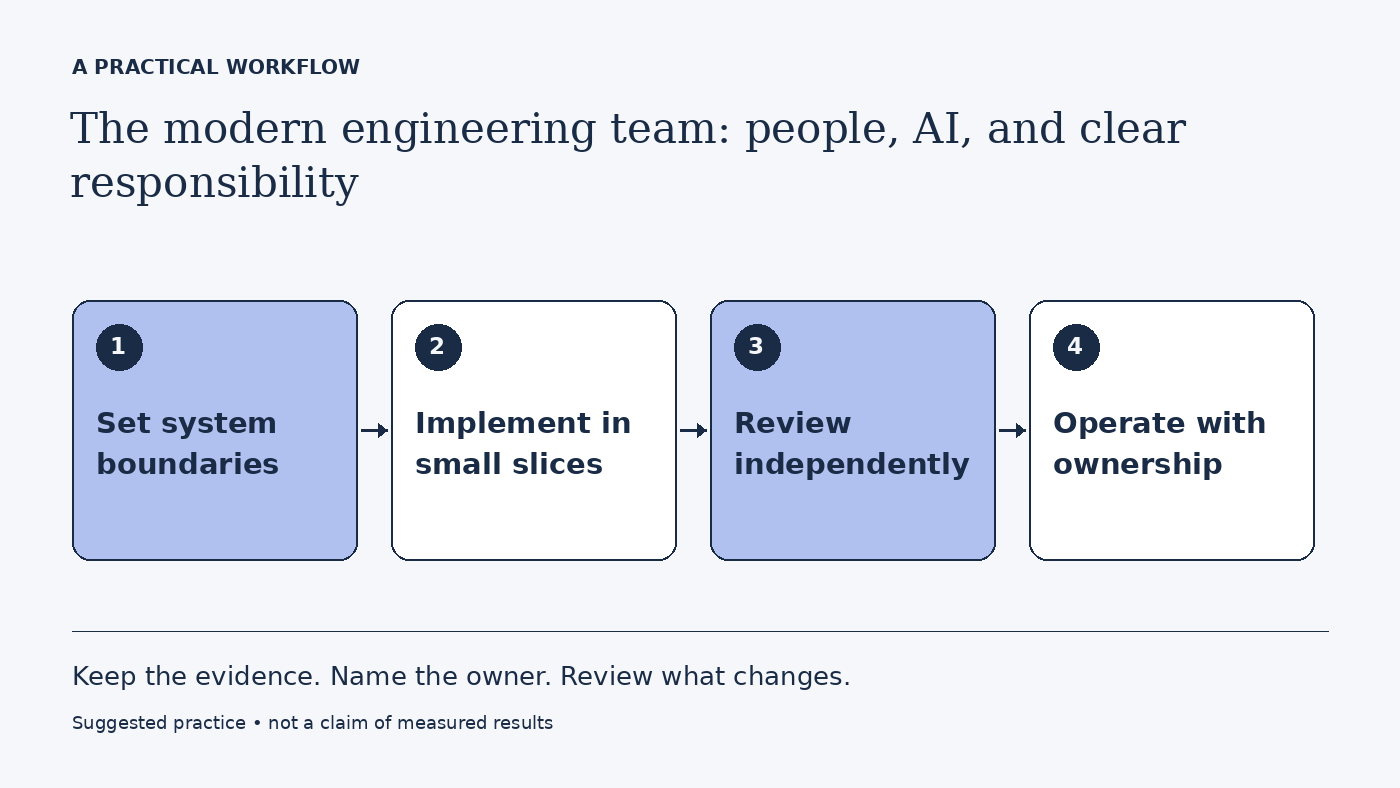
Organize the team around accountable responsibilities and review capacity. AI can support implementation and investigation, while people own system boundaries, acceptance, release decisions, and operations.
In this guide
- Map responsibilities before assigning agents
- Treat review capacity as a real constraint
- A worked example: a feature team with coding assistance
- Use an explicit working agreement
- Measure engineering outcomes without false precision
- A team agreement prompt
- Revisit the model as the product changes
- Continue with a related guide
- Apply this with a practical template
- Bring in a specialist for a bounded implementation
An engineering team is a system for making and maintaining decisions about software. AI can increase the amount of code and analysis produced inside that system. The resulting benefit depends on whether the team can understand, verify, and operate what it produces.
There is no single AI-era organization chart. A useful design begins with the product's complexity, the consequences of failure, and the skills available to inspect the work.
Map responsibilities before assigning agents
Product and design clarify the problem and experience. Engineering establishes interfaces, data ownership, and implementation strategy. Quality work checks behavior and failure paths. Operational work covers deployment, monitoring, incident response, and maintenance.
These responsibilities can overlap across people. They should not become invisible because an agent is labeled architect or QA. A role prompt is an instruction to software, not an accountable owner.
Treat review capacity as a real constraint
If agents produce changes faster than people can inspect them, the team accumulates uncertainty. Limit concurrent work and keep changes small enough to understand. Define the expected behavior before implementation and preserve the evidence used to judge it.
Review should include the actual diff, relevant tests, and behavior in the intended environment. An AI summary can orient the reviewer, but it cannot replace reading the consequential changes. Give reviewers time to challenge the approach rather than only check formatting.
A worked example: a feature team with coding assistance
Imagine a hypothetical team adding a customer export. A product partner clarifies which records should be included. An engineer defines authorization and data boundaries. AI drafts part of the implementation and suggests tests.
Another engineer checks that an account cannot export another account's records. Design reviews progress, empty, and error states. The team tests a large export, a canceled request, and a failed storage operation. An operational owner confirms logging and rollback behavior.
The agent contributed useful work, but it did not eliminate the need for the responsibilities around it. The exact staffing can vary; the boundaries must still be covered.
Use an explicit working agreement
For each assisted task, record the allowed repository area, tools, context, expected artifact, and stop conditions. Keep secrets and production access outside a task unless they are needed and authorized. Use application and infrastructure permissions to enforce limits.
Require a handoff containing changes made, checks run, results, and unresolved issues. Treat retrieved documents and repository content as material to inspect, not authority to broaden the task. A clear boundary reduces accidental scope growth and makes review easier.
Measure engineering outcomes without false precision
DORA's 2025 research emphasizes organizational capabilities around AI adoption. It does not establish a universal staffing ratio. Within your team, inspect delivery time, failure, recovery, rework, and whether the intended user capability improved.
Avoid comparing individuals by generated code volume. Include maintenance and review effort, and look for work moved to another team. A local speedup can coexist with a slower overall release process.
A team agreement prompt
Draft an AI-assisted engineering working agreement for this product and team. Define responsibility for architecture, implementation, review, testing, release, and operations. Specify allowed actions, handoff evidence, and stop conditions for AI tasks. Identify the review bottleneck and propose a limit on concurrent work. Keep accountability assigned to people.
Revisit the model as the product changes
An arrangement that works for a prototype may fail under real customer load. Review ownership after incidents, new integrations, and team changes. The modern engineering team is effective when it can explain its system and improve it deliberately, not merely produce more changes.
Continue with a related guide
- Forward-deployed developers: from customer workflow to production handoff
- Agile engineering with AI: keep the Definition of Done meaningful
Apply this with a practical template
A forward-deployed developer’s production handoff checklist
Bring in a specialist for a bounded implementation
If the team lacks an integration, evaluation, or production-review skill, consider a freelance engineer for a defined milestone. Compare relevant work samples, agree on a paid scope, and name the person responsible for review. Document repository access, acceptance checks, maintenance, and the handoff before work starts. A freelancer can fill a skills gap; product and release decisions still need an accountable owner.
Affiliate disclosure: We may earn a commission if you become a qualifying Upwork customer through this link.
Explore hiring an engineering specialist on Upwork. Evaluate candidates for your actual system and budget; marketplace availability is not a guarantee of fit.
Questions you might be asking
Can AI be the technical lead?
It can support technical analysis, but a person or accountable team must own architecture and consequential decisions.
What is the best human-to-agent ratio?
There is no universal ratio. Start from task boundaries, risk, review capacity, and measured operating results.
Sources and further reading
Put the practice to work
Explore the CoFounder documentation and training library for the implementation context relevant to your project.