Forward-deployed developers: from customer workflow to production handoff
Understand the engineering work behind a deployment, including integrations, acceptance criteria, operability, and reusable product learning.
The useful starting point
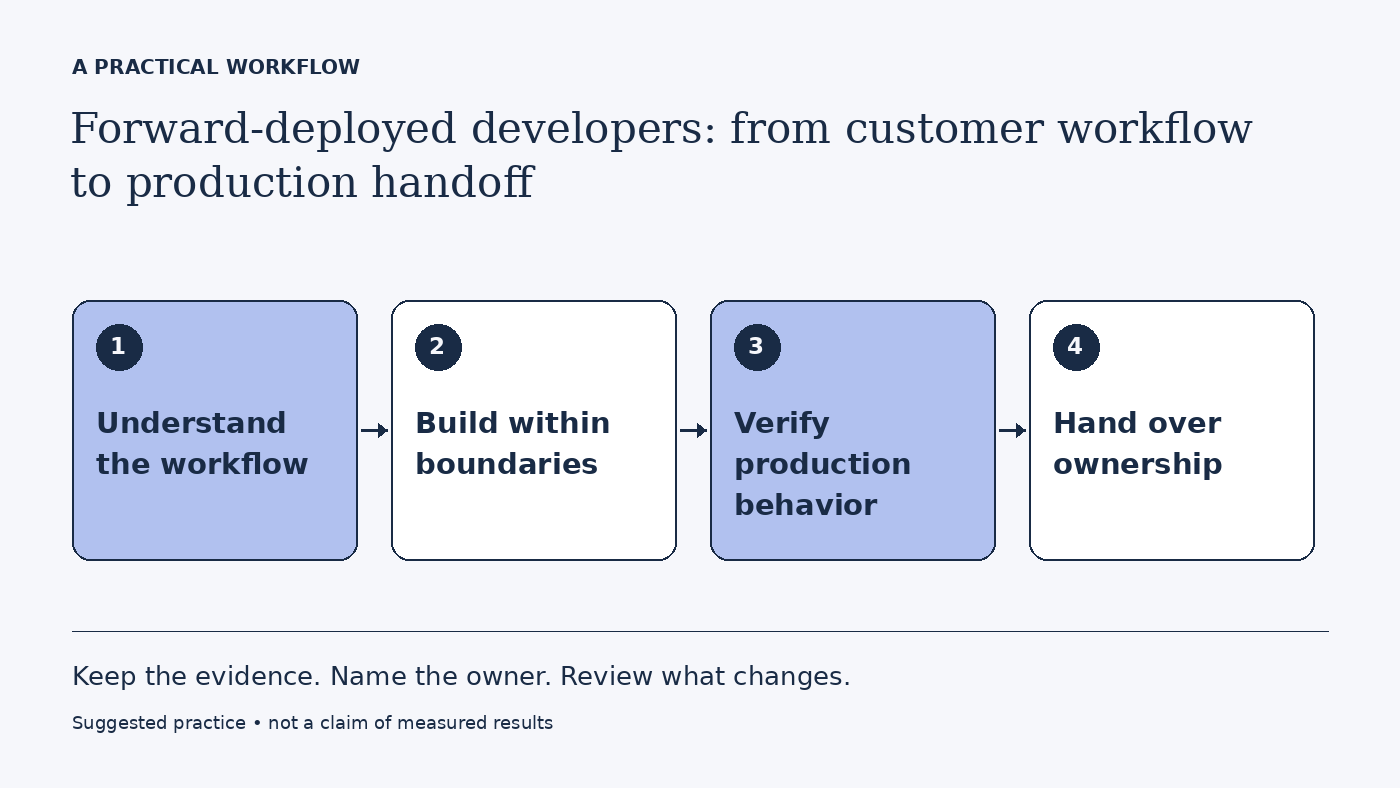
A forward-deployed developer works close to a customer problem and delivers technical changes in that setting. Define the outcome, integration boundaries, production checks, and ownership after handoff before the work expands.
In this guide
- Translate the workflow into a technical contract
- Draw the boundary around custom work
- A worked example: a customer onboarding connector
- Use AI assistance without losing the system model
- A deployment brief prompt
- Finish with an operational handoff
- Continue with a related guide
- Apply this with a practical template
- Bring in a specialist for a bounded implementation
Forward-deployed developer is often used alongside forward-deployed engineer or software engineer. Palantir's published role distinction emphasizes customer technical and operational outcomes. Other employers may organize the work differently, so scope and decision rights matter more than the title.
The engineering challenge is to make a useful solution work inside a customer's real environment. That includes incomplete data, existing tools, permissions, operating habits, and the person who must support the result after the initial deployment.
Translate the workflow into a technical contract
Observe the current task with its owner. Identify the starting event, required inputs, intended result, and exceptions. Write down which system is authoritative for each important field. Clarify what the implementation may read and change.
Then agree on acceptance criteria. A successful demonstration may show that an integration can return a record. A useful production criterion also describes correct handling of missing data, permissions, repeated requests, and downstream failures.
Draw the boundary around custom work
Separate configuration, reusable integration code, and customer-specific logic. Record why each belongs where it does. Avoid quietly embedding one customer's policy into a shared platform behavior.
Keep changes reviewable and preserve an upgrade path. A quick workaround may be appropriate during discovery, but name its owner, limits, and retirement condition. Otherwise the experiment becomes permanent infrastructure through neglect.
A worked example: a customer onboarding connector
Imagine a hypothetical platform importing approved customer records from a CRM. The first prototype works on a clean export. Real use reveals duplicate identifiers, deleted accounts, and fields with different meanings across teams.
The developer agrees on a source-of-truth mapping with the operational owner. They add validation, record-level errors, and a stable identifier for repeated imports. Ambiguous records go to a review queue instead of overwriting a known value.
Before release, they test a partial failure and a retry. They confirm that the customer can see what completed and what needs attention. The goal is not just an import that runs, but an understandable process the customer can operate.
Use AI assistance without losing the system model
AI can draft mappings, propose test cases, and explain code. Give it bounded tasks with explicit interfaces and constraints. Check generated assumptions against the actual API and data model. Keep customer data in approved environments and use representative synthetic fixtures when possible.
A model-generated test may repeat the same mistaken assumption as the implementation. Review the expected behavior independently and include cases derived from the customer's workflow.
A deployment brief prompt
Create an implementation brief from this approved workflow and interface documentation. Specify inputs, source-of-truth fields, outputs, permissions, validation, duplicate handling, partial failure, retry behavior, and rollback. Separate reusable code from customer-specific policy. List unknowns and acceptance tests. Do not invent API capabilities or treat a prototype as production-ready.
Finish with an operational handoff
Provide configuration instructions, observability, known limits, support ownership, and a recovery exercise. Have the receiving team perform a routine change and explain a failure scenario. Record field evidence that may inform the shared product.
A good forward-deployed engagement leaves both a working implementation and a clearer understanding of the customer's problem. If every future adjustment requires the original engineer, the handoff is not finished.
Continue with a related guide
- The modern engineering team: people, AI, and clear responsibility
- Agile engineering with AI: keep the Definition of Done meaningful
Apply this with a practical template
A forward-deployed developer’s production handoff checklist
Bring in a specialist for a bounded implementation
If the team lacks an integration, evaluation, or production-review skill, consider a freelance engineer for a defined milestone. Compare relevant work samples, agree on a paid scope, and name the person responsible for review. Document repository access, acceptance checks, maintenance, and the handoff before work starts. A freelancer can fill a skills gap; product and release decisions still need an accountable owner.
Affiliate disclosure: We may earn a commission if you become a qualifying Upwork customer through this link.
Explore hiring an engineering specialist on Upwork. Evaluate candidates for your actual system and budget; marketplace availability is not a guarantee of fit.
Questions you might be asking
Is a forward-deployed developer only an integration engineer?
Integrations are common, but scope can include workflow discovery, application development, deployment, and product feedback. Confirm the actual role.
Who owns the code after the engagement?
Agree on repository, maintenance, support, access, and escalation ownership before delivery. The title does not establish those terms.
Sources and further reading
Put the practice to work
Explore the CoFounder documentation and training library for the implementation context relevant to your project.