A forward-deployed developer’s production handoff checklist
Make an embedded implementation maintainable with a runbook, explicit ownership, observable failures, and a rehearsed recovery path.
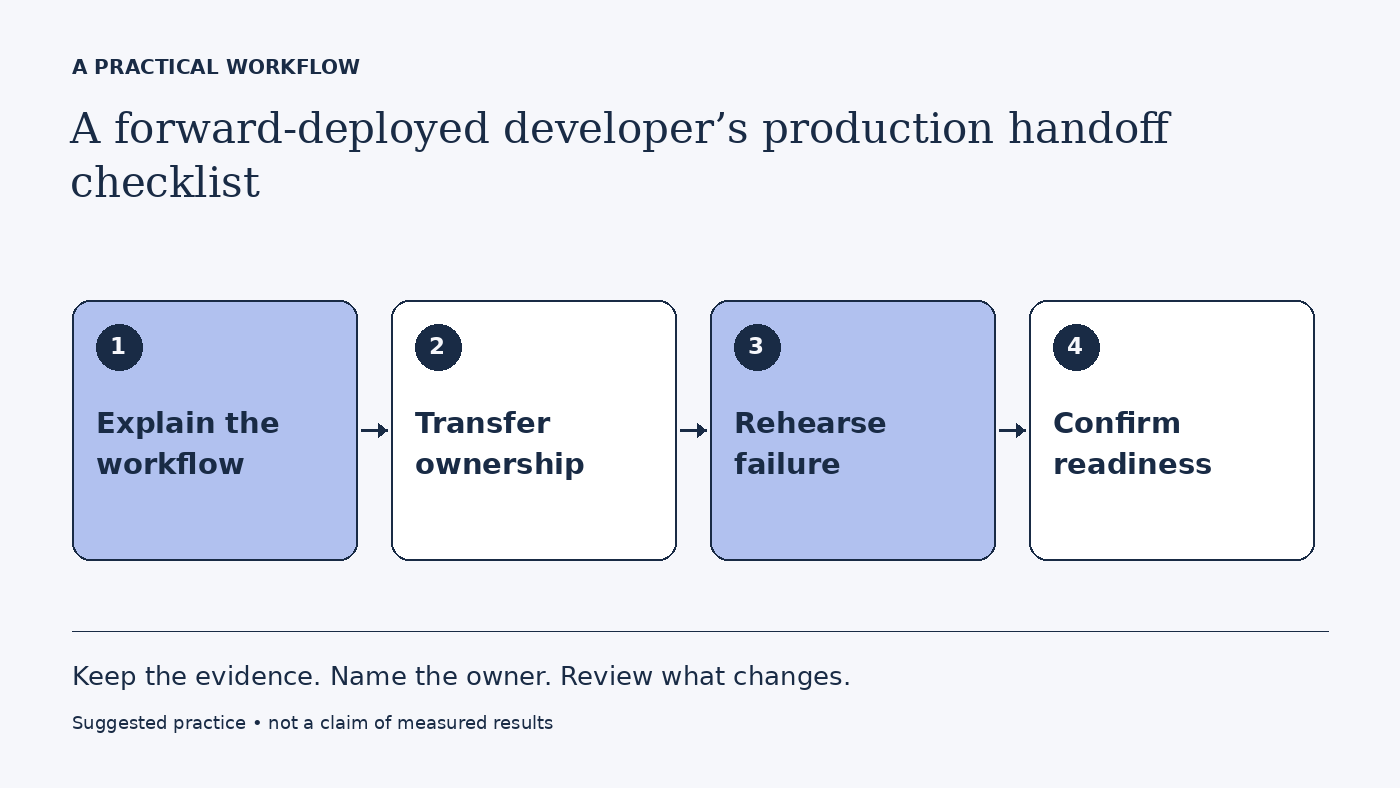
The useful starting point
A handoff is ready when the receiving team can operate, change, diagnose, and recover the implementation. Transfer the decisions and working knowledge alongside the code.
In this guide
An embedded implementation can work during a demonstration and still leave the customer dependent on the developer who built it. The gap is often operational knowledge: which assumptions matter, where failures appear, and who can safely make a change.
This checklist is an original handoff template for a forward-deployed developer or an embedded engineering team. Adapt it to the system and the customer's responsibilities. A checklist cannot certify production readiness on its own; the receiving team needs to demonstrate the relevant tasks.
Explain the workflow before explaining the code
Describe the customer task, the trigger, the inputs, and the useful final result. Walk through a normal case and an exception. Identify the product boundary: which behavior belongs to the reusable product and which part is specific to this customer?
Record the important tradeoffs. If a temporary manual step was chosen because an upstream integration was unreliable, explain that decision and what would justify revisiting it. Otherwise, a later maintainer may remove a step that was quietly protecting the workflow.
Copy the ownership checklist
- Business owner: Who decides whether the workflow still meets the customer need?
- Engineering owner: Who reviews changes and maintains the implementation?
- Operational owner: Who sees failures, responds, and communicates with affected users?
- Data owner: Who approves access, handles corrections, and understands retention requirements?
- Support route: Where does a user report a problem, and what information should they include?
- Exit boundary: What support remains available from the embedded team, for how long, and under what agreement?
Use named people or maintained team roles with a clear contact route. A department name alone can conceal an unowned responsibility.
Create a runbook someone else can use
- System map: Components, external dependencies, and the direction of data movement.
- Deployment record: Repository, environment, released version, and the documented release procedure.
- Configuration: Required settings and where authorized maintainers manage them; never paste secret values into the runbook.
- Observability: Logs, useful metrics, alerts, and examples of normal versus failed operation.
- Recovery: How to pause the workflow, limit impact, restore a known-good version, and verify recovery.
- Known limitations: Unsupported cases, manual steps, unresolved defects, and their owners.
- Change procedure: The review, validation, and customer communication needed for a release.
For systems that change persistent data, restoring an older application version may not undo those data changes. Document recovery constraints explicitly and have the responsible engineers review the approach for that system.
Rehearse a realistic failure
Choose a safe test environment and an agreed scenario: an upstream service times out, an input lacks a required field, or a duplicate event arrives. Ask the receiving team to find the relevant signal, determine the impact, and follow the runbook.
For an event-driven workflow, discuss retries, duplicate processing, and how an operator identifies unfinished work. The right behavior depends on the application; do not assume that retrying every failed action is harmless.
Record where the runbook was unclear and revise it while the embedded developer is available. A rehearsal is evidence about a specific scenario, not proof that every failure has been covered.
Add AI-specific checks when they apply
If the implementation uses a model, record the task, model configuration, prompt or instruction version, permitted tools, and evaluation cases. Explain where a person reviews the output and what happens when the model cannot produce an acceptable result.
The receiving team should be able to compare a proposed model or prompt change against examples that matter to the customer. Include troublesome cases and unsupported inputs, not only a set of successful demonstrations.
Use a receiving-team acceptance review
Ask a maintainer to make a small approved change, locate a failure, and explain the recovery path without relying on undocumented coaching. Review any remaining dependency on the embedded team and agree on an owner and date for closing it.
DORA's 2025 research describes AI as an amplifier of an organization's existing capabilities. Our practical application is to invest in the operating system around the code: clear ownership, usable feedback, and the ability to recover when the implementation behaves differently from the demo.
Build on the earlier guides
Questions you might be asking
Does handing over the repository finish the engagement?
No. The receiving team also needs appropriate access, operating knowledge, documented decisions, and an agreed support boundary.
What if the customer cannot operate it yet?
Record the gap and agree on a support arrangement or a narrower release. Do not label the handoff complete while essential responsibilities remain unowned.
Sources and further reading
Put the practice to work
Explore the CoFounder documentation and training library for the implementation context relevant to your project.